
Here's your passport
Do you read to see yourself or others?


On a Saturday in early October 1889, a rather small 25-year-old man nonchalantly opened his peddler stand in the Washington Market near 4th and Bainbridge Streets in South Philadelphia. Julius Moskowitz was dressed uncharacteristically all in white, and he was muttering to himself as he set out sacks of grains, stealing the occasional glance at the Love of Mercy Synagogue across the street.
Moskowitz, an immigrant arrived the year before from Romania, wasn’t supposed to be working on the sabbath, let alone the holiest day of the year, Yom Kippur. But this was an act of protest. An anarchist mocking and goading the old-world traditionalists inside the temple who he scorned for holding the community back—and it worked. When they came outside during a break in prayer some of the men confronted Moskowitz. The Irish policemen on the South Street beat ran over and then when they witnessed the religious men assaulting the radical peddler, they threw them in the paddy wagon.
I was so struck by this episode and what it illustrated about the historical complexities of American Judaism (and indeed the man, Moskowitz, who was jailed for anarchism and later became religious and founded the burial society) that in 2018 I turned it into a novel, Everything is Borrowed. Now, according to news reports and this recent long-form piece by Eyal Press of the New Yorker, and the experience of countless families, American Jewish communities are painfully fracturing again, this time over deeply held personal beliefs around Israel and Gaza, and it’s tearing people apart, splintering political alliances, and, as we saw in 2024, capable of swaying elections amidst a context of both genocidal terror on the part of the Israeli government and increasing global antisemitism.

The events of October 7, 2023 and its brutal aftermath have made honest, open discourse nearly impossible. All of us are susceptible to this, to being so attached to certain positions we become unable and unwilling to listen. Polarization that has stressed our civil society to the breaking point.
It may be our responsibility as writers to speak to the now, but without perspective, how do we even know what we’re talking about? That’s what motivates me, who spends a lot of time documenting history, to transform present day reality into fiction. Novels give us the chance to see our complexities more clearly and more deeply through distance. To experience the world we occupy not buried in it, but from a place apart, and therefore with the potential to see it as something mythic and fluid. This can disrupt even the idea of firm and inflexible positions. Perhaps that’s why, according to recent data, fiction sales are up and nonfiction is down. In this fraught moment, with social media making everything feel more claustrophobic, we need stories to find our way back to shared humanity.
My small contribution this season is the novel Partly Strong, Partly Broken, observing the fragility of even our dearest communities. It takes place in a fictional New Jersey town almost exactly in the same location as the synagogue in the New Yorker article—only rather than picking up from October 7, the novel reveals the growing fissures already in place, that the events since October 7 have simply exploded.
The novel centers on a rabbi struggling to hold her New Jersey congregation and her multifaith coalition together in the month before October 7, the pressures already mounting. The novel’s publisher, Doug Gordon, wrote recently that “each character has a different take on what’s happening, and these intersecting viewpoints help us see a larger, rounder truth. There are thoughtful folks in the story, and some not so thoughtful, even ignorant, but it’s important to know all of them.”
I hope that curiosity guides the reader. In marketing the book, Doug and I and others involved have noted a tension. Is this novel for Jewish readers about a Jewish topic or is this for everyone? Is it for everyone because a novel is a way to transport oneself, “le plus beau passeport,” as the renowned French journalist and novelist Olivier Weber has said, or because it’s about all of us? A passport to the grieving and confusion inside everyone? The stubborn hope and beauty? The complexity of being human? I think you know where I stand on this question.
In 1891, in that other period of conflict among American Jews, during one of the least tolerant ages in American history, the peddler Julius Moskowitz was held for trial, along with three other Jewish immigrant anarchists, for seditious acts and disturbing the peace. The judge, Craig Biddle, a man, it seems stuffed with importance, declared the anarchists “enemies to the human race.” Such incendiary language and lack of perspective and curiosity—well, it sounds all too familiar. But through fiction something else has a chance to emerge. That was my intention with Everything is Borrowed and it continues now with Partly Strong, Partly Broken. In the former case an all-too human man suffers loss, takes responsibility, and discovers by the end of his days a chance for mercy. In the present novel, a woman dedicated to her community struggles to reconcile her values, her commitments, and the world lit on fire all around.
* * *
“[A] sobering novel...reveals the discord already roiling in liberal Jewish communities...inquisitive and perspective-inclusive,” says Foreword Reviews.
“Partly Strong, Partly Broken…is a work full of compassion and understanding as it explores the difficult questions around politics and racism that vex us today,” says the More to Come blog.
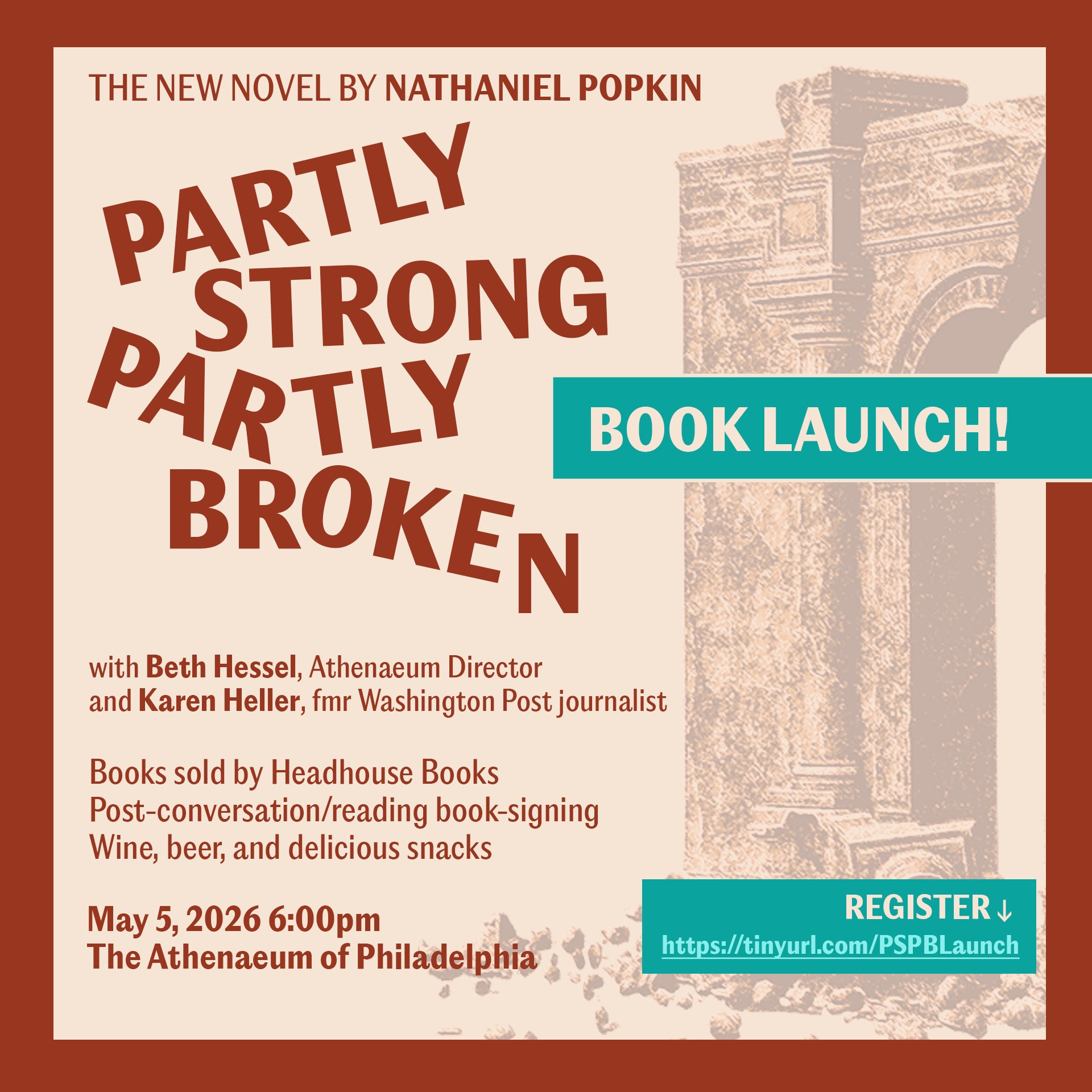
Partly Strong, Partly Broken launches with award-winning journalist Karen Heller, May 5 at the Athenaeum of Philadelphia. Limited seats still available, register HERE.
On May 8, I present the novel along with novelist Lauren Grodstein at Inkwood Books in Haddonfield, NJ. Info HERE.
On May 14, join me and History Making Productions for the premier of In Pursuit Episode 3: Independence 1763-1790 (watch trailer) at the Pennsylvania Academy of the Fine Arts. Film + curator-led gallery tour. Register HERE.
On May 17, meet me at Narberth Books. Info HERE.
On May 20, I participate in the Broad Street Review 2026 BSR Book Week Panel, 5-7PM. Registration for the virtual panel HERE.